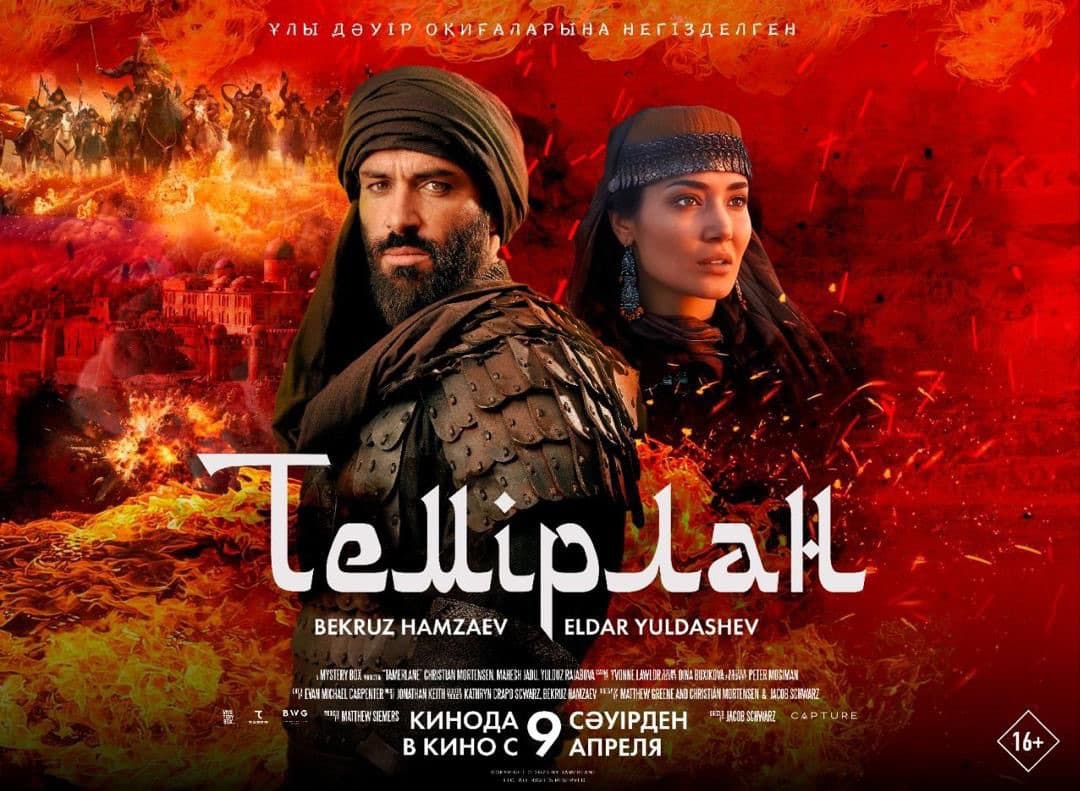
The 2026 historical epic Tamerlane (internationally titled Tamerlane: Rise of the Last Conqueror), a co-production involving the United States, Uzbekistan, and Kazakhstan, arrives as a cinematic paradox of staggering ambition and glaring narrative deficiency. The film aspires to fuse the visceral, kinetic energy of American action cinema with the authentic, sweeping grandeur of the Central Asian steppe, yet the resulting hybrid is less a seamless fusion than a lopsided centaur: visually magnificent and impeccably mounted on one hand, yet dramatically hollow and structurally inept on the other. While the production values, location work, and lead performance command a certain degree of respect, the screenplay consistently undermines these strengths by substituting depth with spectacle and character development with a string of borrowed Hollywood gimmicks that ultimately ring hollow.
To begin with the film’s undeniable merits, the visual and technical execution is of a remarkably high standard. Eschewing the artificiality of soundstages and green-screen backdrops, the production team committed to extensive on-location shooting across Uzbekistan and Kazakhstan, and the payoff is tangible in every frame. The vast, undulating steppes and the stark, imposing mountain ranges are not merely backdrops but active participants in the narrative, grounding the story in a tactile, breathing reality that few recent historical dramas have managed to achieve. The costume design, weaponry, and set decoration are rendered with meticulous attention to detail, providing an immersive sense of 14th-century Central Asia that feels lived-in rather than merely dressed up. The cinematography further elevates the material by skillfully alternating between the region’s characteristic meditative wide shots where human figures are dwarfed by the immensity of the landscape and a more kinetic, Western-style editing rhythm during the numerous battle sequences. The combat scenes, particularly the grueling «battle in the mud,» are staged with a visceral brutality and physical authenticity that suggest a genuine respect for the genre’s demands, proving that the filmmakers knew exactly how to marshal their resources when it came to sheer spectacle.
Furthermore, lead actor Christian Mortensen embodies the title role with a palpable physicality and a commanding presence that the script rarely affords him. His towering frame, deep, resonant voice, and inherent gravitas lend the character a necessary air of authority and burgeoning menace. It is evident that Mortensen invested himself deeply in the part, having reportedly spent a year immersing himself in the regional culture and studying Sufism and Tengrism, an effort that manifests in a certain weary, internalized weight behind his gaze. His Tamerlane is a man of action, and Mortensen convinces in the saddle and with a blade in hand. Regrettably, the screenplay consistently fails to reward his commitment with anything resembling psychological complexity, leaving the actor stranded in a film that prioritizes the clash of swords over the clash of internal convictions.
This brings us to the film’s Achilles’ heel: a screenplay so devoid of narrative sinew that it collapses under the weight of its own visual opulence. The film seems to operate under the misguided assumption that a relentless barrage of large-scale skirmishes can adequately compensate for a wholesale neglect of exposition and character interiority. Instead of revealing the formation of a conqueror’s psyche through action and subtle visual storytelling, the narrative repeatedly defaults to on-the-nose dialogue that explains motives rather than dramatizing them. Secondary characters are outlined verbally but rarely granted the space to evolve through their deeds, rendering them as narrative props rather than fully realized individuals. The film’s central antagonist, for instance, is a particularly egregious misfire: a villain so devoid of charisma and credible menace that the final confrontation feels less like a clash of titans and more like a routine errand, thereby draining the film’s climax of any genuine stakes or catharsis.
Nowhere is the film’s addiction to surface-level gloss over substantive depth more glaringly exposed than in its ill-conceived and pervasive chess allegory. Throughout the runtime, the audience is bludgeoned with the notion that Tamerlane is a master strategist and that life itself is akin to a grand chess match. This heavy-handed motif eventually culminates in a pivotal scene wherein the hero «outmaneuvers» the villain in an actual game of chess, a sequence staged with the slick, rapid-fire editing style and smug visual shorthand popularized by the Ocean’s Eleven franchise. The scene is a masterclass in hollow Hollywood confectionery a brief, flashy «wow» moment designed for a trailer rather than a film committed to intellectual rigor.


LCKAI
Aperture — LCK AI Assistant
ЗАПИСЬ ● ЭФИР